General Discussion
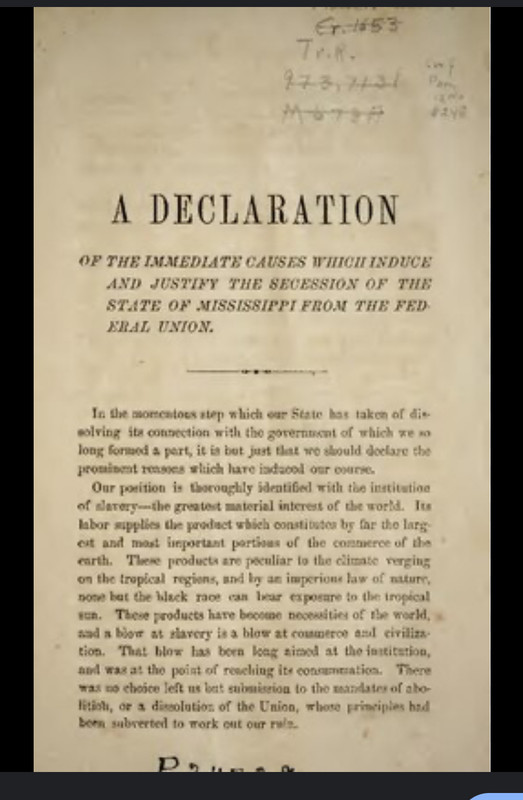
Related: Editorials & Other Articles, Issue Forums, Alliance Forums, Region ForumsContrary to the prevailing rewrite of our history, all of the seceding states seemed to think the Civil War: slavery
Contrary to the prevailing rewrite of our history, all of the seceding states seemed to think the Civil War was entirely about slavery.
A compendium to Bryan’s work…
https://www.battlefields.org/learn/primary-sources/declaration-causes-seceding-states
Applegrove:
I was in US history class in high school in Ottawa, Canada when our teacher announced it was States Rights not Slavery that the US Civil War was fought over. That was in the early 1980s. That was some massive international rewrite.
 = new reply since forum marked as read
Highlight:
NoneDon't highlight anything
5 newestHighlight 5 most recent replies
= new reply since forum marked as read
Highlight:
NoneDon't highlight anything
5 newestHighlight 5 most recent replies

BOSSHOG
(44,738 posts)Slavery and states rights were one and the same. Confederate states wanted the right to have slaves, the union be damned. Today “states rights” continue to be a dog whistle for the racist ear.

applegrove
(130,670 posts)in a way the word "slavery" would not encourage a continued Confederacy. It worked.
Most States Rights stuff was definitely slavery, but there was also a lot of skepticism about a strong national government period, especially in the first 3-4 decades of our country's existence. Thomas Jefferson argued states didn't have to accept the Supreme Court decisions they didn't like.

yardwork
(69,019 posts)Thomas Jefferson owned slaves.

ITAL
(1,271 posts)However, slavery didn't feature in Jefferson's writings on the matter by and large. His belief that states were the ultimate arbiters on if they should follow the laws of the national government really came to the fore with the Alien and Sedition Acts -- not slavery.

marble falls
(71,281 posts)
bucolic_frolic
(54,262 posts)South was agrarian and relied on slave labor as raw input to the system. They had less manufacturing, relying mostly on imports from England and other European countries. Plantation owners were very wealthy, just like in Barbados.
The North had factories and businesses, partially protected by tariffs that were lobbied for by the same business interests that put Abraham Lincoln at the head of the Republican Ticket. When Lincoln swooned 'freedom and opportunity' workers loved it, but business knew it meant no regulations and rampant growth. Lincoln was known as a small town lawyer for the people, but he also had railroad clients and real estate investments in a growing rail hub.

AZProgressive
(29,870 posts)Big business used to support an expanded federal government because that meant things like railroad contracts but now that US has grown so large and powerful big business wants to significantly reduce that for fewer regulations and labor rights and the enforcement behind that.
My reply to the OP is I learned right here at DU around the same time I first joined that the Southeast states specifically mentions slavery in their letters of secession.

Marcuse
(8,820 posts)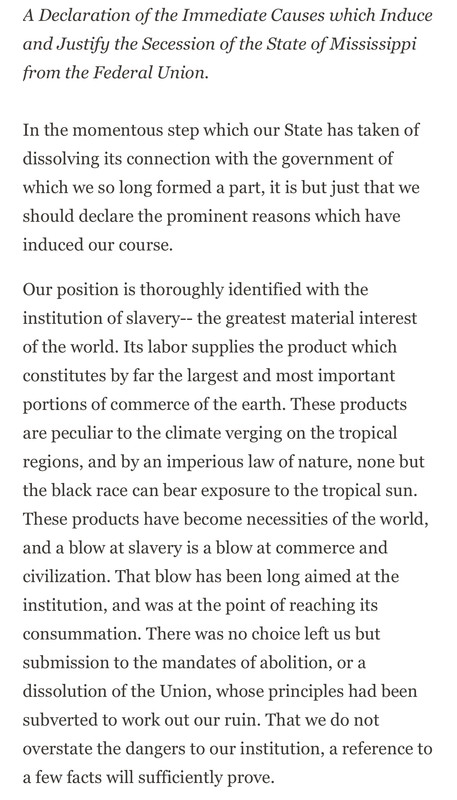
NeoConfederates have been much more abstract until now:
https://www.thenation.com/article/archive/exclusive-lee-atwaters-infamous-1981-interview-southern-strategy/

Buckeyeblue
(6,236 posts)There was a moral imperative to end slavery. Otherwise, Lincoln could have just let the south go. Their economy was unsustainable. But the war to end slavery was worth the fight.

Sin
(479 posts)
sweetapogee
(1,213 posts)Virginia was the only state that lost land as a result of the American Civil War. On June 20, 1863 the state of West Virginia, made up of many western counties of Virginia, was admitted into the union. When I was in college, my West Virginia history professor started every lecture saying, "a child born of civil strife". His opinion, and one that makes a lot of sense to me, was that had the Confederacy prevailed, that same Confederacy would have at a later date, but probably within the 19th century, split into two confederacies, an eastern with a capitol in Richmond VA and another mainly centered around Texas. The reasons for this are complex but if you look at our southern states today, the economy is centered around industry and technology which has an appetite for semi-skilled/skilled workers and is centered in urban areas which is much different from rural plantation farm economy where the main cash crop is not edible. To quote General Longstreet's character played by Tom Berenger in the movie Gettysburg, speaking to R.E. Lee, he said "we should have freed the slaves, then fired on Fort Sumter". And Lee doesn't argue with him. In a representative republic such as we have here, political power is everything and the industrialists wanted to keep that advantage from the planter class, plain and simple. There is no scenario where slavery would have survived in the long term in the US, the ACW simply accelerated the demise. It cost the northern (US) taxpayers I think about 9 million dollars per day in 1860s dollars to fight the war. There was not enough money in the southern states to compete with that long term. Confederate (state) script was basically worthless by April 1865, huge tracts of land were laid waste.