Kim-Pong Tam, Susumu Ohnuma, Malcolm Fairbrother, Hoi-Wing Chan
Published: December 10, 2025
https://doi.org/10.1371/journal.pclm.0000755
Abstract
As public support influences policy choices, it is crucial to understand how people view climate policies. Based on the premise that individuals tend to be conditional cooperators, we derived the “They Reduce, We Reduce” hypothesis, according to which citizens’ support for climate policies in their own country is higher if they perceive a stronger climate effort by other countries. We tested this hypothesis with a survey study (N = 4,000) in China, India, Japan, and the United States. Findings show that participants who perceived that other countries were likely and willing to take action to reduce climate change, or that the major emitters in the world were currently making substantial efforts, were more supportive of implementing climate policies in their own country. We also observed interindividual variations in this effect, though the patterns differed between countries: The policy attitudes of individuals who felt personally obligated to combat climate change and those who supported their country’s unconditional efforts were less tied to such perceptions. These findings suggest that people respond to other countries’ actions, and policy attitudes should be understood in the context of global climate governance, with reciprocity playing an important role in mobilizing public support.
…
…
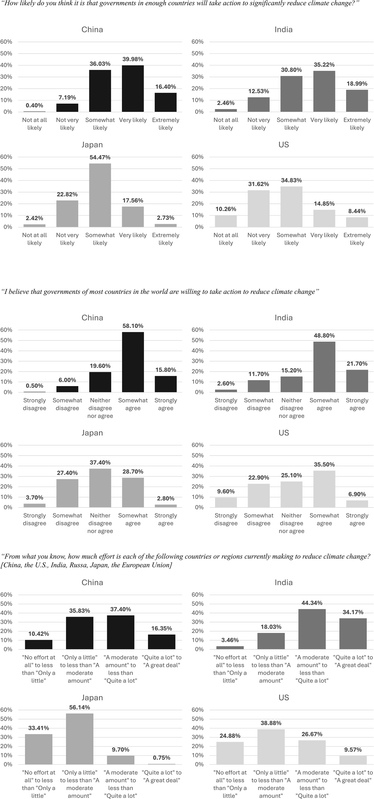
Regarding LIKELY, the full sample mean was slightly above the scale mid-point. 38.54% of the participants reported “very likely” or “extremely likely,” as opposed to 22.43% for “not at all likely” or “not very likely.” Similarly, for WILLING, the full sample mean was above the scale mid-point. 54.58% of the participants reported “somewhat agree” or “strongly agree,” as opposed to 21.10% for “somewhat disagree” or “strongly disagree.” In sum, the average perception based on all participants, regardless of country, can be said to be on the positive or optimistic side. Because the actual items for EFFORT varied between the four countries, we did not examine the full-sample results.
There were some noticeable differences between the four country samples. Specifically, there seemed to be more positive or optimistic perceptions among Chinese and Indian participants. Counting the Japanese and American samples alone, the average view was either around the mid-point or significantly below the mid-point. On the contrary, in the Chinese and Indian samples, the average view was almost always significantly above the mid-point. This pattern was consistently observed in LIKELY, WILLING, and EFFORT. These cross-national differences are potentially interesting and require future attention.
It is notable that LIKELY, WILLING, and EFFORT were moderately to strongly correlated with each other (see Table 2). That is, participants who perceived higher likelihoods of climate action by other countries also tended to report the perceptions that other countries were willing to contribute and that top emitters in the world were trying to reduce climate change. This observation suggests that the three measures converge to the same construct.
…
