Welcome to DU!
The truly grassroots left-of-center political community where regular people, not algorithms, drive the discussions and set the standards.
Join the community:
Create a free account
Support DU (and get rid of ads!):
Become a Star Member
Latest Breaking News
Editorials & Other Articles
General Discussion
The DU Lounge
All Forums
Issue Forums
Culture Forums
Alliance Forums
Region Forums
Support Forums
Help & Search
Cooking & Baking
Related: About this forumFour Winter Peach Pies From "PIE" 🌞
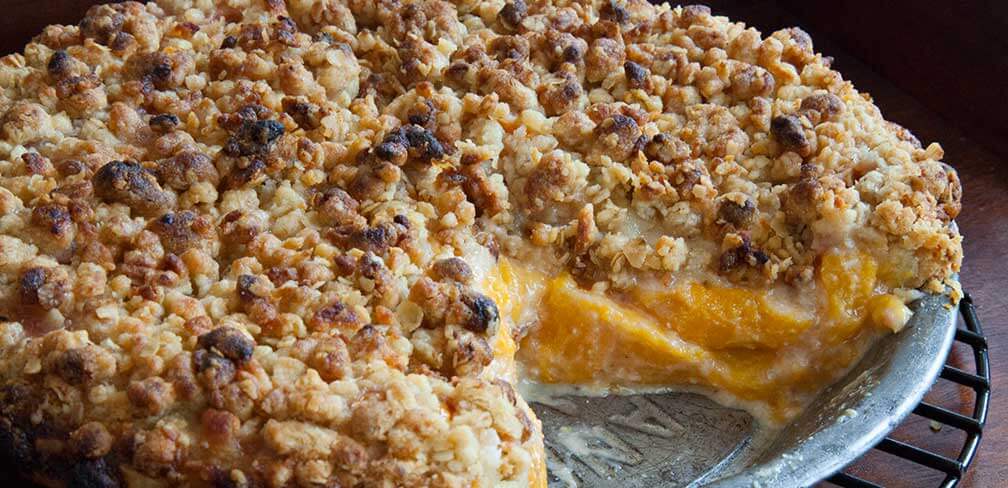
All-Peach Pie with Coconut-Almond Crumb Topping
We all know that the season for truly good, ripe peaches is short—far
shorter than the amount of time they occupy supermarket produce
aisles during the summer months. When the quality of peaches is not
what it should be, I like to use frozen fruit instead. Frozen peaches are
a relative bargain, compared to fresh or canned, and the quality is very
good. I'll repeat here what I say elsewhere: the quality of frozen
produce in this country is quite often superior to that of fresh, in large
part because there is very little time between harvesting and
processing. That said, you can make an excellent peach pie with
frozen fruit. I like to add a good amount of lemon juice and zest, both
of which lend an aura of freshness, and a little nutmeg and vanilla to
replace those subtle flavor notes that get lost in the processing.
MAKES 8 TO10 SERVINGS
1 recipe **Basic Flaky Pie Pastry , Single Crust, refrigerated
FILLING
2 1-pound bags frozen sliced peaches, partially thawed
1½ tablespoons fresh lemon juice
Finely grated zest of 1 lemon
⅓ cup plus 3 tablespoons sugar
2 tablespoons cornstarch
½ teaspoon vanilla extract
¼ teaspoon ground nutmeg
COCONUT -ALMOND CRUMB TOPPING
1 cup all-purpose flour
⅔ cup sugar
¼ teaspoon salt
½ cup sliced almonds
½ cup sweetened flaked coconut
6 tablespoons (¾ stick) cold unsalted butter , cut into ¼-inch pieces
1 tablespoon milk
1. If you haven't already , prepare the pastry and refrigerate until firm
enough to roll, about 1 hour .
2. On a sheet of lightly floured waxed paper, roll the pastry into a
13-inch circle with a floured rolling pin. Invert the pastry over a
9½-inch deep-dish pie pan, center, and peel off the paper . Gently
tuck the pastry into the pan, without stretching it, and sculpt the
overhang into an upstanding ridge. Place in the freezer for 15 minutes.
3. Combine the peaches, lemon juice, lemon zest, and ⅓ cup of the
sugar in a large bowl and toss well to mix. Set aside for 10 minutes to
juice. Preheat the oven to 400°F .
4. In a small bowl, mix the cornstarch with the remaining 3
tablespoons sugar . Sprinkle this mixture over the fruit and mix
well. Stir in the vanilla and nutmeg. Turn the filling into the chilled
pie shell and smooth the filling with your hands to even it out.
Place the pie on the center oven rack and bake for 35 minutes.
5. Meanwhile, make the topping. Combine the flour, sugar , salt,
almonds, and coconut in a food processor and pulse several times
to mix. Scatter the butter over the top and pulse until the mixture
resembles fine crumbs. Add the milk and process again until the
crumbs are gravelly. Transfer to a large bowl and rub gently between
your fingers to make the crumbs uniform in texture. Refrigerate until
ready to use.
6. Remove the pie from the oven and reduce the temperature to 375°F .
Carefully dump the crumbs in the center of the pie and spread them
evenly with your hands. Press on the crumbs gently to compact them.
Return the pie to the oven, placing it so that the part that faced the
back of the oven now faces forward. Just in case, slide a large
aluminum foil-lined baking sheet onto the rack below to catch any
spills. Bake until the juices bubble thickly around the edge, about 30
minutes.
7. Transfer the pie to a wire rack and let cool for at least 1 hour before
serving.
Recipe for Success
The juiciest pies, such as this one, seem to need a very thick layer
of crumb topping, the way we do it here. If you use too little
topping, it tends to just soak into the juice, and you end up with a
sludge-topped pie rather than a crumb-topped pie. Don't worry if
you think there's too much topping. Use all of it, and the pie will
be great.
**Basic Flaky Pie Pastry
This pie pastry is used frequently throughout this collection because it
yields such excellent results. I sometimes call it a half-and-half pastry,
referring to the equal amounts of vegetable shortening and butter—
the former for flakiness, the latter for flavor. It can be made in a food
processor if you have a large-capacity machine. But I'll repeat my
usual advice, which is to make it by hand or with an electric mixer if
you don't. Both methods are quite easy. If you could have only one
pastry to work with, this would probably be it.
MAKES A SINGLE OR DOUBLE CRUST FOR A 9-INCH STANDARD
PIE OR 9 1/4-INCH DEEP-DISH PIE
FOR A SINGLE CRUST
1 1/2 cups all-purpose flour
1 1/2 teaspoons sugar
1/2 teaspoon salt
1/4 cup (stick) cold unsalted butter, cut into %-inch pieces
1/4 cup cold vegetable shortening, cut into pieces
1/4 cup cold water
FOR A DOUBLE CRUST
3. cups all-purpose flour
1 tablespoon sugar
1 teaspoon salt
1/2 cup (1stick) cold unsalted butter, cut into 1/4 inch pieces
1/2 cup cold vegetable shortening, cut into
1/2 cup cold water
1. TO MAKE IN A FOOD PROCESSOR
Put the flour, sugar, and salt in the food processor. Pulse several
times to mix. Scatter the butter over the dry ingredients and pulse
the machine 5 or 6 times to cut it in. Fluff the mixture with a fork,
lifting it up from the bottom of the bowl.
Scatter the shortening over the flour and pulse 5 or 6 times. Fluff
the mixture again. Drizzle half of the water over the flour mixture
and pulse 5 or 6 times. Fluff the mixture and sprinkle on the remaining
water. Pulse 5 or 6 times more, until the dough starts to form clumps.
Overall, it will look like coarse crumbs. Dump the contents of the
processor bowl into a large bowl. Test the pastry by squeezing some
of it between your fingers. If it seems a little dry and not quite
packable, drizzle a teaspoon or so of cold water over the pastry and
work it in with your fingertips.
TO MAKE BY HAND
Combine the flour, sugar, and salt in a large bowl. Toss well,
by hand, to mix. Scatter the butter over the dry ingredients
and toss to mix. Using a pastry blender, 2 knives, or your
fingertips, cut or rub the butter into the flour until it is broken
into pieces the size of small peas. Add the shortening and
continue to cut until all of the fat is cut into small pieces.
Sprinkle half of the water over the mixture.
Toss well with a fork to dampen the mixture. Add the remaining
water, 1 1/2 to 2 tablespoons at a time, and continue to toss and
mix, pulling the mixture up from the bottom of the bowl on the
upstroke and gently pressing down on the downstroke. Dough
made by hand often needs a bit more water. If necessary, add
water 1 or 2 teaspoons at a time until the pastry can be packed.
TO MAKE WITH AN ELECTRIC MIXER
Combine the flour, sugar, and salt in a large bowl. Add the butter,
tossing it with the flour. With the mixer on low speed, blend the
butter into the flour until you have what looks like coarse, damp
meal, with both large and small clumps.
Add the shortening and repeat. Turning the mixer on and off,
add half of the water. Mix briefly on low speed. Add the remaining
water, mixing slowly until the dough starts to form large clumps.
If you're using a stand mixer, stop periodically to stir the mixture up
from the bottom of the bowl, do not overmix.
When using a food processor, after you've added the shortening,
pulse 3 or 4 times. Add 1 cup (1/2 cup for single crust) finely
shredded sharp cheddar cheese and pulse 3 or 4 times more.
Add the water and proceed as directed above. When making the
dough by hand or with an electric mixer, add the cheese after you
have cut or mixed in all of the fat. Toss with your hands to mix, then
add the water as instructed for each method.
Recipe for Success
I use this pastry so often that I tend to make it in large batches.
More than half of the time required to make pastry is spent
getting out the ingredients, putting them away, and washing the
utensils. That said, I may make a double batch of crust, 3 or 4 times
over, then freeze it for up to a month. I wrap each disk in plastic,
then in aluminum foil. I take the dough out of the freezer the day
before I plan to use it and let it thaw in the fridge. It works like a charm.
************************************************************************
Peaches and Cream Pie
This open-faced pie tastes like peach ice cream—not surprising,
since the three main ingredients are peaches, cream, and
confectioners' sugar . In summer , try to use fresh peaches if you
have them, but you'll get an excellent pie with frozen peaches as
well. The finishing touch is a sprinkling of brown sugar that goes
on for the last 15 minutes of baking, giving the pie a delicious
caramel coating. Plan ahead, because you have to chill this pie before serving.
MAKES 8 TO10 SERVINGS
1 recipe Basic Flaky Pie Pastry , Single Crust (see above), **All-Butter Pie
Pastry, Single Crust, refrigerated
FILLING
2½ to 3 cups peeled, pitted, and sliced ripe peaches or one
1-pound bag frozen sliced peaches, partially thawed
1 cup heavy or whipping cream
½ cup confectioners' sugar , sifted
Big pinch of salt
½ teaspoon vanilla extract
½ cup firmly packed light brown sugar
1. If you haven't already , prepare the pastry and refrigerate until firm
enough to roll, about 1 hour .
2. On a sheet of lightly floured waxed paper, roll the pastry into a
13-inch circle with a floured rolling pin. Invert the pastry over a
9½-inch deep-dish pie pan, center, and peel off the paper . Tuck
the pastry into the pan, without stretching it, and sculpt the edge
so it is more or less flush with the top of the pan. Place in the
freezer for 15 minutes. Preheat the oven to 400°F .
3. Distribute the peach slices evenly in the chilled shell. Combine the
cream, confectioners' sugar, salt, and vanilla in a medium-size bowl
and whisk to blend. Slowly pour the cream over the peaches. Use a
fork, if necessary , to rearrange the peach slices evenly in the shell.
4. Place the pie on the center oven rack and bake for 30 minutes.
Remove from the oven and reduce the temperature to 350°F .
Sprinkle the brown sugar evenly over the pie, then return it to the
oven, placing it so that the part that faced the back of the oven
now faces forward. Bake until the filling is bubbly and the top is
caramel-colored, 15 to 20 minutes. The filling will still be liquid.
5. Transfer the pie to a wire rack and let cool thoroughly . Cover with
loosely tented aluminum foil and refrigerate for at least 4 hours or
overnight before serving.
Recipe for Success
Unlike other similar recipes, this is not a custard pie, because it
contains no eggs. Thus, as I indicate in the recipe, the filling
typically looks liquidy when the pie comes out of the oven. Don't
bake the pie longer , though, in hopes that the filling will firm up.
The thickening occurs as the pie cools.
How to Blanch a Peach
One bite of a peach is all it takes to tell whether you'll want to
peel your pie-bound fruit: If the skin is thick and chewy , peel it.
If not, you probably don't have to bother.
If you're going to peel, you can, of course, use a sharp paring
knife. If you're good, you won't remove much of the precious
flesh underneath. If you're not, you may want to consider
blanching.
To blanch your peaches, bring 2 to 3 quarts of water to a boil
in a large saucepan. Using a slotted spoon, lower the peaches into
the boiling water one at a time. Count to 15, then remove the
peach. Let it cool briefly , then just slide off the skin. The first one
is your test peach: if the skin doesn't slip right off, give the next
one 30 seconds. The trick is to submerge the peach just long
enough to loosen the skin, but not so long that the flesh
underneath gets too soft, making it difficult to handle when you
slice it.
**All-Butter Pie Pastry
I'm very fond of this all-butter pastry for a number of reasons. One,
with all the butter you just can't argue with the flavor. The butter also
gives it a nice gold color, even more so if you make the sturdy version
with the egg yolk (see Recipe for Success). It's easy to roll and handle,
too, which is why I often choose to use this pastry at my baking
demonstrations. It isn't as flaky as some of the other crusts—all-butter
pastries never are—but the advantages make this a good pastry to
have in your repertoire. Of all the pastries in this collection, I think this
is the easiest one to make in a food processor.
MAKES A SINGLE OR DOUBLE CRUST FOR A 9-INCH STANDARD PIE
OR 9½-INCH DEEP-DISH PIE
FOR A SINGLE CRUST
1½ cups all-purpose flour
1½ teaspoons sugar
½ teaspoon salt
½ cup (1 stick) cold unsalted butter, cut int ¼-inch pieces
¼ cup cold water
FOR A DOUBLE CRUST
2¾ cups all-purpose flour
1 tablespoon sugar
1 teaspoon salt
1 cup (2 sticks) cold unsalted butter, cut into ¼-inch pieces
About ½ cup cold water
1. TO MAKE IN A FOOD PROCESSOR
Put the flour, sugar, and salt in the food processor. Pulse several
times to mix. Scatter the butter over the dry ingredients and pulse
7 or 8 times to cut the butter in well. Remove the lid and fluff the
mixture with a fork, lifting it up from the bottom of the bowl.
Drizzle half of the water over the dry ingredients. Pulse 5 or 6
times, until the mixture is crumbly. Fluff the pastry and sprinkle on
the remaining water. Pulse 5 or 6 times more, until the pastry starts
to form clumps. Overall, it will look like coarse crumbs. Dump the
contents of the processor bowl into a large bowl.
TO MAKE BY HAND
Combine the flour, sugar, and salt in a large bowl.
Toss well, by hand, to mix. Scatter the butter over the dry ingredients
and toss to mix. Using a pastry blender, 2 knives, or your fingertips,
cut or rub the butter into the flour until it is broken into pieces the size
of split peas. Sprinkle half of the water over the dry mixture. Toss well
with a fork to dampen the mixture. Add the remaining water in 2
stages and continue to toss and mix, pulling the mixture up from the
bottom of the bowl.
TO MAKE WITH AN ELECTRIC MIXER
Combine the flour, sugar, and salt in a large bowl. Add the butter,
tossing it with the flour. With the mixer on low speed, blend the
butter into the flour until you have what looks like coarse, damp
meal. Turning the mixer on and off, add half of the water.
Mix briefly on low speed. Add the remaining water, mixing
slowly until the dough starts to form large clumps. If you're using
a stand mixer, stop periodically to stir the mixture up from the
bottom of the bowl. Do not overmix.
2. Test the dough by squeezing some of it between your fingers; if it
seems a little dry and not quite packable, drizzle a teaspoon or so of
cold water over the dough and work it in with your fingertips. Using
your hands, pack the dough into a ball (or 2 balls if you are making a
double crust) as you would pack a snowball. If you're using this to
make a double-crust pie, make one ball slightly larger than the other;
this will be your bottom crust. Knead each ball once or twice, then
flatten the balls into ¾-inch-thick disks on a floured work surface.
Wrap the disks in plastic and refrigerate for at least an hour or
overnight before rolling.
Recipe for Success
Make sure the butter is good and cold—right from the fridge—
especially if you're making this in a food processor, because the
friction created by the machine softens it fairly quickly.
Remember not to let the pastry ball up around the food processor
blade. You want to stop running the machine when the pastry is
still in clumps.
All-butter pastry turns pretty firm in the fridge. If it's refrigerated
for more than an hour, give it 5 to 10 minutes at room temperature
before rolling. Note that the dough can be frozen for up to a
month.
To make a sturdier pastry, one with slightly more durability—
useful, say, when you're making a freeform pie—add 2 large egg
yolks to the double-crust recipe and 1 large egg yolk to the single
crust recipe. Put them in a glass measuring cup and add enough
water to equal the required amount of liquid for that recipe. Blend
with a fork, then add to your pastry as usual.
Butter Bits
The word "butter" comes from the Greek bous, meaning "cow,"
and tyros, meaning "cheese." As early as 1850, the expression "to
butter" meant to flatter. It didn't become "butter up" until the
late 1930s.
By government edict, all butter must contain at least 80 percent
milkfat.
The remaining 20 percent of butter is made up of 18 to 18.5
percent water and 1 to 2 percent curd, or milk solids.
"Sweet butter" is a term used for unsalted butter.
************************************************************************

Lemonade-Peach Pie
Fresh peaches and lemonade concentrate give this pie an
unmistakable summer flavor . The store-bought frozen pie
shell lets you get this in the oven in a thrice. The crunchy
streusel topping takes less than five minutes to prepare
and adds a delicious finish.
MAKES 8 SERVINGS
1 store-bought frozen 9-inch deep-dish pie shell
FILLING
4 cups peeled, pitted, and thinly sliced ripe peaches
⅓ cup frozen lemonade concentrate, thawed
¼ cup sugar
2½ tablespoons quick-cooking tapioca
STREUSEL TOPPING
¾ cup all-purpose flour
⅓ cup sugar
¼ teaspoon ground cinnamon
⅛ teaspoon salt
5 tablespoons cold unsalted butter , cut into ¼-inch pieces
1. Remove the pie shell from the package but leave it in the freezer.
Preheat the oven to 400°F .
2. Combine all the filling ingredients in a medium-size bowl. Turn
the filling into the frozen pie shell and smooth the top with a spoon.
Place the pie on the center oven rack and bake for 25 minutes.
3. Meanwhile, make the topping. Put the flour, sugar , cinnamon, and
salt in a food processor and pulse several times to mix. Scatter the
butter over the top and pulse until the mixture resembles fine crumbs.
Empty the crumbs into a medium-size bowl and rub between your
fingers to make large, buttery crumbs. Refrigerate until ready to use.
4. Remove the pie from the oven and reduce the temperature to 375°F.
Carefully dump the crumbs on the pie, spreading them evenly over the
surface with your hands. T amp them down lightly . Return the pie to
the oven, placing it so that the part that faced the back of the oven
now faces forward. Just in case, slide a large aluminum foil-lined
baking sheet onto the rack below to catch any drips. Continue to bake
until the topping is golden brown and the juices bubble thickly around
the edge, about 25 minutes.
5. Transfer the pie to a wire rack and let cool for at least 2 hours
before serving.
Recipe for Success
Remember to be careful when handling store-bought pie shells,
because the edges tend to get brittle as they bake. The best way to
get them in and out of the oven is by using a small rimless baking
sheet as an oversize spatula, sliding it under the pan.
Instead of peaches, substitute fresh nectarines, if you like.
****************************************************************************

Deep-Dish Nectarine Pie with Almond Crumb Topping
Here's a little tip: all of the stone fruits—peaches, nectarines, apricots,
and plums—have an affinity for almonds, a flavor that can be used to
your advantage. This juicy , summer -fresh nectarine pie flavored with
almond extract and topped with an almond streusel is one of the pies
I most look forward to making come midsummer . Choose your
nectarines carefully . If they have a green tinge, they will not ripen
properly . Like peaches, they should yield to gentle finger pressure
but not feel mushy , as they sometimes do, given their habit of
overripening quickly . There's no need to peel the skins; they soften
up nicely as the pie bakes.
MAKES 8 TO10 SERVINGS
1 recipe Basic Flaky Pie Pastry , Single Crust or **Extra-Flaky Pie
Pastry , Single Crust, refrigerated
FILLING
6 cups pitted and sliced ripe nectarines, unpeeled
Scant ½ cup plus 2 tablespoons sugar
1½ tablespoons fresh lemon juice
2 teaspoons grated lemon zest
2½ tablespoons cornstarch
¼ teaspoon almond extract
ALMOND CRUMB TOPPING
¾ cup whole or slivered almonds
½ cup sugar
½ cup all-purpose flour
¼ teaspoon salt
6 tablespoons (¾ stick) cold unsalted butter , cut into ¼-inch pieces
1. If you haven't already , prepare the pastry and refrigerate until firm
enough to roll, about 1 hour .
2. On a sheet of lightly floured waxed paper, roll half of the pastry
into a 13-inch circle with a floured rolling pin. Invert the pastry over
a 9½-inch deep-dish pie pan, center , and peel off the paper . Tuck
the pastry into the pan, without stretching it, and sculpt the edge
into an upstanding ridge. Place in the freezer for 15 minutes.
Preheat the oven to 400°F .
3. In a large bowl, combine the nectarines, ½ cup of the sugar, the
lemon juice, and lemon zest. Set aside for 10 minutes to juice.
Combine the remaining 2 tablespoons sugar and the cornstarch
in a small bowl, then stir the mixture into the fruit. Stir in the almond
extract. Scrape the filling into the chilled pie shell, smoothing the
fruit with a spoon. Place the pie on the center oven rack and bake
for 30 minutes.
4. Meanwhile, make the topping. Combine the almonds and sugar in a
food processor , pulsing in short bursts to chop the almonds well. Add
the flour and salt and pulse briefly to mix. Scatter the butter over the
dry ingredients and pulse until the mixture looks like fine crumbs.
Dump the crumbs into a large bowl and rub between your fingers to
make large, buttery crumbs. Refrigerate until ready to use.
5. Remove the pie from the oven and reduce the temperature to
375°F . Carefully dump the crumbs in the center of the pie, spreading
them evenly and tamping them lightly with your hands. Return the pie to the
oven, placing it so that the part that faced the back of the oven now
faces forward. Just in case, slide a large aluminum foil-lined baking
sheet onto the rack below to catch any spills. Continue to bake until
the juices bubble thickly around the edge, 30 to 40 minutes.
6. Transfer the pie to a wire rack and let cool for at least 2 hours before
serving.
Recipe for Success
The same filling can be used in a double-crust pie or with a
different crumb topping.
If you'd like to try a nectarine-blueberry combination, reduce the
nectarines by 2 cups and add 2 cups ripe fresh blueberries.
**Extra-Flaky Pie Pastry
This is perhaps the best behaving of all the pastries in this
collection, thanks to the addition of cake flour. The benefit of
cake flour is twofold: it makes the pastry more shrink-resistant
when it is prebaked, and it makes the pastry extra tender and
flaky, due to the soft nature of the wheat used in the flour. This
pastry can be used for just about any pie, but it's a particularly
good choice when the filling is somewhat refined or delicate.
Make it by hand or with an electric mixer if you don't have a
large-capacity food processor.
MAKES A SINGLE OR DOUBLE CRUST FOR A 9-INCH STANDARD
PIE OR 9½- INCH DEEP-DISH PIE
FOR A SINGLE CRUST
1 cup all-purpose flour
⅔ cup cake flour
1 tablespoon sugar
½ teaspoon salt
¼ cup (½ stick) cold unsalted butter, cut into ¼-inch pieces
5 tablespoons cold vegetable shortening, cut into pieces
¼ cup cold water
FOR A DOUBLE CRUST
2 cups all-purpose flour
1 cup cake flour
1 tablespoon sugar
1 teaspoon salt
½ cup (1 stick) cold unsalted butter, cut into ¼-inch pieces
½ cup plus 2 tablespoons cold vegetable shortening, cut into pieces
½ cup cold water
1. TO MAKE IN A FOOD PROCESSOR
Put the flours, sugar, and salt in the food processor. Pulse several
times to mix. Scatter the butter over the dry ingredients and pulse
5 or 6 times to cut it in. Fluff the mixture with a fork, lifting it up
from the bottom of the bowl. Scatter the shortening over the flour
and pulse 5 or 6 times. Fluff the mixture again. Drizzle half of the
water over the flour mixture and pulse 5 or 6 times. Fluff the
mixture and sprinkle on the remaining the water. Pulse 5 or 6 more
times, until the dough starts to form clumps. When it reaches this
point, do not continue to process. Empty the crumbs into a
large bowl.
TO MAKE BY HAND
Combine the flours, sugar, and salt in a large bowl
and mix well. Scatter the butter over the dry ingredients and cut or rub
it in, using a pastry blender, 2 knives, or your fingertips until the butter
is broken into fine pieces. Add the shortening and repeat. Sprinkle half
of the water over the dry mixture. Toss well with a fork to dampen the
mixture. Add the remaining water in 2 stages and continue to toss and
mix. Add more water if needed. Typically, hand-mixed pastry will
require a little more water than machine-mixed.
TO MAKE WITH AN ELECTRIC MIXER
Combine the flours, sugar, and salt in a large bowl. Add the butter
and toss with the flour. With the mixer on low speed, blend the
butter into the flour until you have what looks like coarse, damp
meal, with both large and small clumps. Add the shortening and
repeat. Turning the mixer on and off, add half of the water and mix
briefly on low speed. Add the remaining water, mixing until the
dough starts to form large clumps. If you're using a stand mixer,
stop periodically to stir the mixture up from the bottom of the
bowl. Do not overmix.
2. Using your hands, pack the dough as you would a snowball. If
making a double crust, divide the dough in half, making one half—
for your bottom crust—a little larger than the other. Knead each
piece 2 or 3 times. Put each in the center of a piece of plastic wrap
and flatten it into a disk about ¾ inch thick. Wrap in the plastic and
refrigerate until firm enough to roll, about an hour or overnight.
Recipe for Success
If you don't have cake flour, substitute ¼ cup of the all-purpose
flour. Sift it into the flour, then proceed as directed. The dough
may be frozen for up to a month.
Those Pastry Trimmings
Every time you trim the edge of a double-crust pie, you're left
with a small handful of dough. What should you do with it? It's
not enough to make another pie, and if you're not making
decorative cutouts, it seems simpler just to toss it.
Here's a better idea. Flatten it into a ¼-inch-thick disk, wrap
it in plastic, slide it into a zipper-topped plastic storage bag, and
put it in the freezer. After you've done this 3 or 4 times, you'll
have enough dough to make another pie shell. Just take the bag
out of the freezer the day before you plan to use it and leave it in
the fridge. Then unwrap and stack the disks, loosely cover with
plastic wrap, and let sit at room temperature until they're soft
enough to roll; they'll fuse together as you do. Don't worry if the
pastries aren't all the same sort; nobody will notice the
difference.
All the above from "PIE"
https://www.goodreads.com/book/show/390288.Pie
Mmmmm Peachy & delicious!


3 replies
 = new reply since forum marked as read
Highlight:
NoneDon't highlight anything
5 newestHighlight 5 most recent replies
= new reply since forum marked as read
Highlight:
NoneDon't highlight anything
5 newestHighlight 5 most recent replies
= new reply since forum marked as read
Highlight:
NoneDon't highlight anything
5 newestHighlight 5 most recent replies
Four Winter Peach Pies From "PIE" 🌞 (Original Post)
justaprogressive
Wednesday
OP

SWBTATTReg
(26,001 posts)1. Can't wait to try out! Thanks for sharing recipes!!

justaprogressive
(6,262 posts)2. Thanks!
Most people don't think of peaches in December...but we should! 
SWBTATTReg
(26,001 posts)3. That was one thing that grabbed me when I read your article. I grew up in the country at my grandma/& great grandma's
house, who had small peach trees growing all over their yard. I loved them!! So, in a way, a nice trip down memory lane...we also had rhubard, blackberries, raspberries, goose berries, just a whole yard full of goodies.