Science
Related: About this forumNASA Fires Up Powerful Lithium-Fed Thruster for Trips to Mars
Pardon me if this has already been posted:
https://www.jpl.nasa.gov/news/nasa-fires-up-powerful-lithium-fed-thruster-for-trips-to-mars/
April 28, 2026
?si=JllJr6Q2Sppvkt51
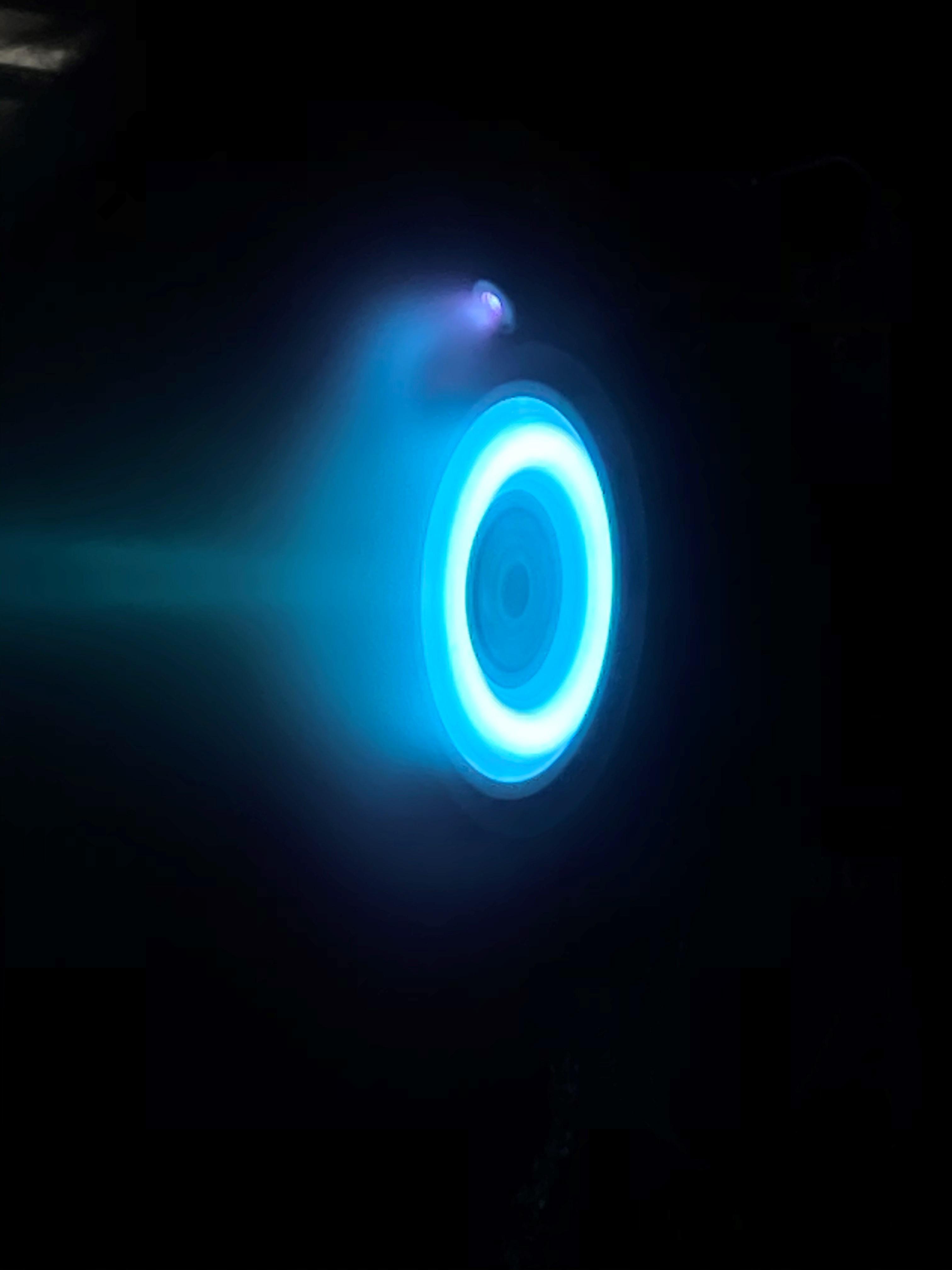
A prototype of a lithium-fed magnetoplasmadynamic thruster was tested in a special chamber at NASA’s Jet Propulsion Laboratory in February 2026. With further development, thrusters like this could be part of a nuclear electric propulsion system powering human missions to Mars. Credit: NASA/JPL-Caltech
A novel electromagnetic thruster passed an initial test in a specialized chamber at JPL. With further development, these thrusters could support human missions to the Red Planet.
A technology that could propel crewed missions to Mars and robotic spacecraft throughout the solar system was recently put to the test at NASA’s Jet Propulsion Laboratory in Southern California. On Feb. 24, for the first time in years and at power levels exceeding any previous test in the United States, a team fired up an electromagnetic thruster that runs on lithium metal vapor.
This prototype achieved power levels beyond the highest-power electric thrusters on any of the agency’s current spacecraft. Valuable data from the first firing of this thruster will help inform an upcoming series of tests.
“At NASA, we work on many things at once, and we haven’t lost sight of Mars. The successful performance of our thruster in this test demonstrates real progress toward sending an American astronaut to set foot on the Red Planet,” said NASA Administrator Jared Isaacman. “This marks the first time in the United States that an electric propulsion system has operated at power levels this high, reaching up to 120 kilowatts. We will continue to make strategic investments that will propel that next giant leap.”
During five ignitions, the tungsten electrode at the thruster’s center glowed bright white, reaching over 5,000 degrees Fahrenheit (2,800 degrees Celsius). The work was conducted in JPL’s Electric Propulsion Lab, home to the condensable metal propellant vacuum facility, a unique national asset for safely testing electric thrusters that use metal vapor propellants at up to megawatt-class power levels.
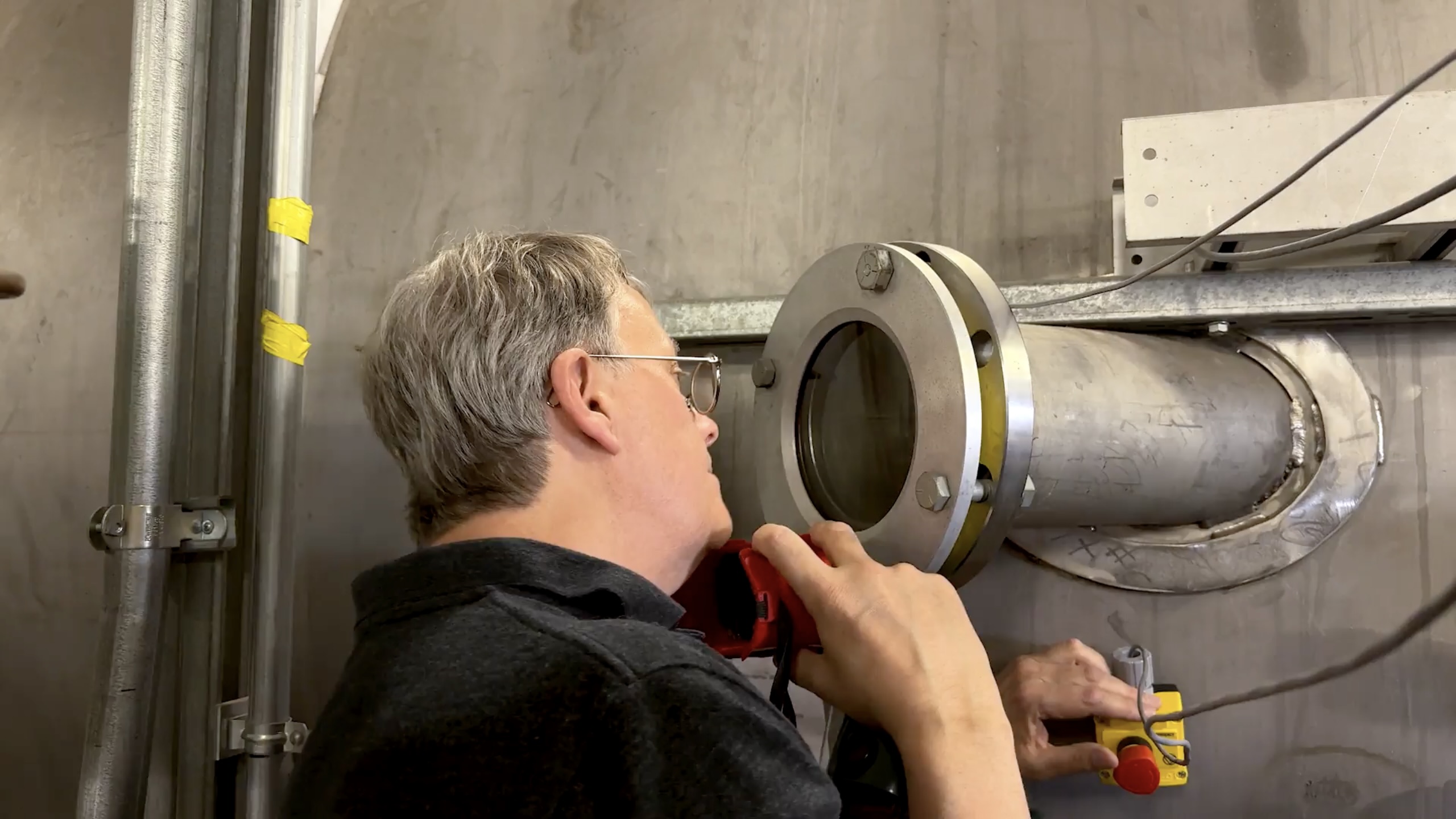
JPL senior research scientist James Polk peers into the condensable metal propellant (CoMeT) vacuum facility at JPL’s Electric Propulsion Lab, where a high-power electric thruster prototype his team developed was being put to the test in February 2026. Credit: NASA/JPL-Caltech
Powering up
Electric propulsion uses up to 90% less propellant than traditional, high-thrust chemical rockets. Current electric propulsion thrusters, like those powering NASA’s Psyche mission, use solar power to accelerate propellants, producing a low, continuous thrust that reaches high speeds over time. NASA JPL is testing a lithium-fed magnetoplasmadynamic (MPD) thruster, a technology that has been researched since the 1960s but never flown operationally. The MPD engine differs from existing thrusters by using high currents interacting with a magnetic field to electromagnetically accelerate lithium plasma.
During the test, the team achieved power levels of up to 120 kilowatts. That’s over 25 times the power of the thrusters on Psyche, which is currently operating the highest-power electric thrusters of any NASA spacecraft. In the vacuum of space, the gentle but steady force Psyche’s thrusters provide over time accelerates the spacecraft to 124,000 mph.
…
 = new reply since forum marked as read
Highlight:
NoneDon't highlight anything
5 newestHighlight 5 most recent replies
= new reply since forum marked as read
Highlight:
NoneDon't highlight anything
5 newestHighlight 5 most recent replies

3Hotdogs
(15,535 posts)
eppur_se_muova
(42,467 posts)more efficiency. This engine uses lithium, the third lightest atom known, so the operating principles must benefit from light atoms in this technology. Smaller atoms are faster-moving at the same temperature compared to heavier atoms, and faster-moving ions would create larger currents and larger magnetic fields. Would be nice to see the math breakdown on this.
If that's correct, use of Li-6 enriched fuel could give a significant performance boost over natural isotopic abundance lithium. DOE currently separates lithium isotopes on a huge scale to use Li-6 in hydrogen bombs. Surely we could spare some that to power a space probe, thereby increasing its acceleration and chances of mission success.
(The IUPAC reports the gradual slow increase in the atomic weight of commercial lithium as the lighter isotope, Li-6, is withdrawn from circulation.)
https://en.wikipedia.org/wiki/Lithium

OKIsItJustMe
(22,077 posts)https://www1.grc.nasa.gov/wp-content/uploads/NERVA-Nuclear-Rocket-Program-1965.pdf
❝With nuclear rockets man will have the capability of much longer range space exploration) because of their inherent superiority over chemical rockets. The NERVA program has demonstrated the feasibility of such nuclear rockets.❞
https://en.wikipedia.org/wiki/Nuclear_thermal_rocket
This thruster is similar to the ones used by Discovery in 2001.

https://ntrs.nasa.gov/api/citations/20070032050/downloads/20070032050.pdf
❝…Propellants of choice for MPD thrusters are hydrogen and lithium, because of their low atomic mass and relatively low ionization energies (Ageyev, 1993 and Lapointe, 2002). Lithium’s very low first ionization energy makes it particularly advantageous at lower powers (0.5 – 5 MW) and moderate exhaust velocities (20-70 km/s). Hydrogen is more amenable to multimegawatt and high specific impulse operations, is easier to supply to the thruster as a gas, and is less likely to condense on spacecraft surfaces.❞
eppur_se_muova
(42,467 posts)In contrast, ionized gases/plasmas interact with both electric and magnetic fields to produce that equal-and-opposite thrust. The electrostatic ion engine seems to be favored by high mass/charge ratio -- high m, low v means a lower delta-mv for the same delta-m(v-squared), I guess. Thrust is controlled by the electric field, whereas the classic rocket equation relies only on thermal energy (from combustion, or nuclear reactor) to give gas molecules velocity. I'm assuming MPD (a variation on MHD, presumably) creates large magnetic fields through discharges in the conducting plasma, but I'm really guessing there -- I'd really like to see a basic-math treatment of both.
OKIsItJustMe
(22,077 posts)As well as this one linked to in the OP. https://alfven.princeton.edu/publications/pdf/polk-iepc-2024.pdf
I gave you the wrong impression by citing the NERVA engine, which, as you say, used a nuclear reactor to heat hydrogen which was then used as a propellant. My (unclear) point was that nuclear-powered engines have been being researched by NASA (and its predecessors) since the mid-50’s.
In the case of the “MPD thruster,” the hydrogen is being used as a plasma.
https://en.wikipedia.org/wiki/Magnetoplasmadynamic_thruster
[link:https://science.nasa.gov/mission/psyche/] uses xenon gas in its ion thrusters.
I read once that Gene Roddenberry rejected the use of ion thrusters for the Enterprise because they were too slow. (In the original series, they occasionally encountered more primitive spaceships which used them (as I recall Khan’s Botany Bay used ion thrusters.)
eppur_se_muova
(42,467 posts)Project Orion has been discussed in many books about the history of the atomic bomb, bios of famous physicists involved in the Manhattan Project, space travel, etc. If you'll search old posts in DU you'll find references to the AF's mockup nuclear-powered bomber and nuclear-H2 engines (mostly about the history of these discontinued projects).
One of the odder ideas was to coat a pusher plate with Cf-254, which decomposes mostly by spontaneous fission. The ejected nuclei would be the reaction mass, and since they travel at marginally-relativistic velocities, the potential terminal velocity would be tremendous. The problem, of course, would be in handling such a huge amount of Cf-254.


erronis
(24,494 posts)How much would be needed to power a manned space trip to Mars - and return?