Anthropology
Related: About this forumAncient Korean society practiced human sacrifice and high inbreeding, researchers find
By Kristina Killgrove
published 18 hours ago
A genomic analysis of dozens of ancient Korean skeletons revealed a special "sacrificial caste" of people.
About 1,500 years ago, entire families were sacrificed to honor local royalty in what is now South Korea, a new genetic study finds. The analysis also reveals a dense kinship system focused on women and their descendants.
In a study published Wednesday (April 8) in the journal Science Advances, an international team of researchers investigated 78 skeletons from the Imdang-Joyeong burial complex in Gyeongsan, located in the southeast region of the Korean Peninsula. The tombs in this cemetery were constructed between the fourth and sixth centuries, during the Three Kingdoms period (circa 57 B.C. to A.D. 668). Historical records suggest that, in the Silla kingdom, people practiced "sunjang," a form of human sacrifice in which servants, or "retainers," were killed and buried with the local elite, and that the society favored "consanguineous" marriage between related individuals.
By analyzing the DNA of 78 skeletons found in the Imdang-Joyeong burial complex, the researchers discovered 11 pairs of people who were first-degree relatives (such as parent and offspring, or siblings) and 23 pairs of people who were second-degree relatives (such as grandparent and grandchild or aunt and niece), suggesting that the Silla society preferred to bury closely related people together.
But the researchers also found five individuals — both royal and nonroyal — whose parents were closely related, including one first-cousin pairing, proving that both the Silla royal elites and the Silla people who were sacrificed to them practiced consanguineous marriage.
More:
https://www.livescience.com/archaeology/ancient-korean-society-practiced-human-sacrifice-and-high-inbreeding-researchers-find?utm_medium=referral&utm_source=pushly&utm_campaign=Archaeology
 = new reply since forum marked as read
Highlight:
NoneDon't highlight anything
5 newestHighlight 5 most recent replies
= new reply since forum marked as read
Highlight:
NoneDon't highlight anything
5 newestHighlight 5 most recent replies

Judi Lynn
(164,183 posts)Findings offer first large-scale evidence of social structure during Silla Kingdom
Vishwam Sankaran
Friday 10 April 2026 12:24 BST
Entire families were sacrificed in Korea about 1,500 years ago in rituals to honour royalty, according to a new analysis of dozens of skeletons unearthed in Gyeongsan in the southeastern region of the Korean Peninsula.
The findings raise further questions about slavery, social mobility, and institutionalised violence in ancient Korean kingdoms.
They also offer the first large-scale scientific evidence of the social structure and customs of the era, proving close-kin marriages were common during the Silla Kingdom (57 BC to 935 AD).
. . .
In the latest study, scientists analysed genome-wide data from 78 human remains unearthed from 44 tombs at the Imdang-Joyeong burial complex in Gyeongsan.
At least 20 of the tombs displayed evidence of "sunjang”, a practice in which individuals were sacrificed and buried alongside the dead.
More:
https://www.independent.co.uk/news/science/archaeology/korea-human-sacrifice-ancient-caste-b2955142.html
~ ~ ~
Wikipedia
Silla
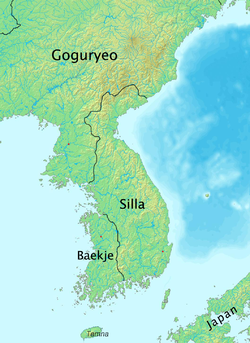
Silla ([ɕiɭ.ɭa]; Old Korean: 徐羅伐, Yale: Syerapel,[8] RR: Seorabeol; IPA: [sʌɾabʌɭ]) was a Korean kingdom that existed between 57 BCE[9] and 935 CE and was located on the southern and central parts of the Korean peninsula. Silla, along with Baekje and Goguryeo, formed the Three Kingdoms of Korea. Silla had the lowest population of the three, approximately 850,000 people (170,000 households), significantly smaller than those of Baekje (3,800,000 people) and Goguryeo (3,500,000 people).[10]
Its foundation can be traced back to the semi-mythological figure of Hyeokgeose of Silla (Old Korean: *pulkunae lit. 'light of the world'), of the Park clan. The country was first ruled intermittently by the Miryang Park clan for 232 years and the Wolseong Seok clan for 172 years and beginning with the reign of Michu Isageum the Gyeongju Kim clan for 586 years. Park, Seok and Kim have no contemporary attestations and went by the Old Korean names of Geoseogan (居西干, 1st century BCE), Chachaung (次次雄, 1st century CE), Isageum (泥師今, Old Korean: *nisokum)[11] and Maripkan (麻立干, 5th–6th century)[12] instead.
It began as a chiefdom in the Jinhan confederacy, part of the Samhan, and after consolidating its power in the immediate area, conquered the Gaya confederacy. Eventually allying with Sui China and then Tang China, it conquered the other two kingdoms, Baekje in 660 and Goguryeo in 668. Thereafter, Unified Silla occupied most of the Korean peninsula, while the northern part re-emerged as Balhae, a successor-state of Goguryeo. After nearly 1,000 years of rule, Silla fragmented into the brief Later Three Kingdoms of Silla, Later Baekje, and Taebong, handing over power to Goryeo in 935.[13]
More:
https://en.wikipedia.org/wiki/Silla

rampartd
(5,434 posts)they were the cooks, scribes, and concubines who accompanied their monarch into the afterlife.
i don't get that they were bred for the single moment of death like thanksgiving turkeys, but that civil service retirement in the silla kingdom may have been colder and darker than we americans might appreciate.

mntleo2
(2,657 posts)We have been a bit worried as you have not been here, and you are the one who makes this forum so special. Whatever reason you are away, please know all you do is appreciated and that we hope all is well with you. It is an excellent forum.
Sincerely, Cat from Seattle